Rank and status anxiety
The Government InspectorRank and status anxiety in The Government Inspector is more than fear of an approaching superior: it is a whole system of behavior, shaping what officials hide, how they present themselves, and what they imagine they might become. The prospect of an incognito inspector makes the town’s hierarchy feel suddenly exposed to judgment. When Khlestakov’s boasts suggest that he occupies a place near the center of power, the officials mistake performance for rank and reveal how readily their own hopes and fears complete the deception.
The Inspector as an Unseen Authority
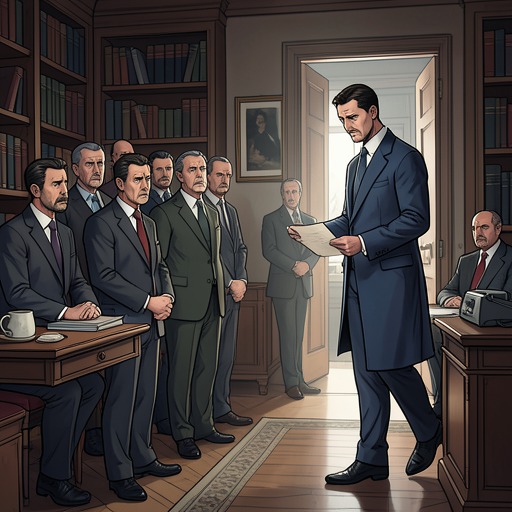
The alarm begins with the news that an inspector has arrived from Saint Petersburg incognito and with secret instructions. The threat is potent precisely because the official is not yet known: he may look in at any moment, summon a judge or the superintendent of charities, and inspect the departments over which they preside. Anton Antonovich Skvoznik-Dmukhanovsky imagines this sudden summons as an exposure that cannot be prepared for once it begins. He therefore tells the officials to make their own arrangements, treating possible scrutiny as a personal danger before any specific accusation has been made.
The thought of being watched also changes how the town is to appear. Anton Antonovich warns Artemy Filippovich Zemlianika to provide clean nightcaps and keep patients from looking as grimy as blacksmiths. He tells Ammos Fiodorovich Liapkin-Tiapkin that geese and goslings are wandering through the courthouse entrance hall, where petitioners wait, and urges him to remove them. These are practical instructions, but their urgency points to a deeper problem: the offices have been allowed to function as they please until the possibility of inspection makes visible disorder seem dangerous. The response is not presented as a sustained reform program; it is a hurried effort to make official spaces look defensible.
The fear reaches beyond the departments into the town’s appearance and its channels of information. Anton Antonovich orders an old fence near a bootmaker pulled down and a post with a wisp of straw put in its place so that the work will resemble grading. He regrets that about forty cartloads of rubbish have accumulated against the fence, yet even this mess becomes material for staging the governor’s activity. He also orders officials to say they are perfectly satisfied and threatens consequences for anyone who says otherwise. The inspection is imagined as a performance in which not only the offices but also public opinion must be managed.
Rank, Surveillance, and Evasion
Anton Antonovich’s instructions expose the gulf between formal responsibility and actual conduct. He calls the courthouse’s poultry problem a matter he had meant to address earlier, then turns to what he treats as the officials’ lesser peccadilloes. Liapkin-Tiapkin readily admits taking bribes, distinguishing the white greyhound puppies he accepts from what he considers more serious corruption. Anton Antonovich, for his part, presents sin as universal and inevitable. In the face of inspection, wrongdoing is not honestly corrected so much as classified, minimized, and kept from becoming an official scandal.
His request to Ivan Kuzmich Shpekin makes the anxiety into a proposal for surveillance. Anton Antonovich suspects that merchants or townspeople may have denounced him and asks the postmaster to open letters and look for information against him, sealing them again or delivering them opened. Shpekin replies that he already reads letters, less from precaution than from curiosity. The exchange joins official self-protection to an existing breach of correspondence: a private communication becomes something the authorities might use to anticipate judgment. The inspector’s unseen scrutiny prompts Anton Antonovich to seek scrutiny of his own, redirecting the pressure rather than answering it.
The same calculation governs his plan for receiving the visitor. Since the inspector seems young, Anton Antonovich thinks it will be easier to pump information out of him than from a hardened older man. He proposes going unofficially, alone or with Piotr Ivanovich Dobchinsky, to see that visitors are properly accommodated. Rank here works through unequal knowledge: the local governor hopes to question the stranger and learn what he knows before the stranger can question the town. Yet the plan depends on reading the visitor correctly, and that confidence will prove misplaced.
Khlestakov’s Borrowed Grandeur
Khlestakov’s account of life in Saint Petersburg supplies the officials with exactly the signs of elevation they are primed to recognize. He describes himself as more than a copying clerk, claiming familiarity with the head of his department, who invites him to dinner and treats him like a brother. He says he can enter the office briefly and direct what should be done, while a copying clerk remains at work and a doorkeeper rushes after him with a shoe brush. The details move between clerical routine and imagined deference, making rank seem legible through gestures of service as much as through a title.
His boasting grows from personal access into an extravagant story of institutional power. Khlestakov claims that his mail is addressed to Your Excellency and that he once took charge of a department after its head disappeared. He describes generals as unable to manage the position and says that the authorities turned to him instead. In his account, thirty-five thousand couriers fill the streets to summon him, and his first passage through the department makes everyone tremble. The scale of the story escalates; so does the officials’ response. Anton Antonovich and the others rise in awe and then tremble as Khlestakov works himself up further.
The scene’s irony depends on the distance between the status Khlestakov performs and the officials’ willingness to believe it. Earlier, Anton Antonovich had thought a young visitor easy to question and manage. Now Khlestakov’s claims reverse the apparent balance: the visitors who were to be accommodated become a supposed power center, and the officials behave as if their own positions are at stake before him. The comedy does not require the claims to be credible in themselves. Their force comes from meeting a town already organized around fear of rank and the hope of advancement through proximity to it.
Titles, Ambition, and the Desire to Rise
The local officials’ own titles and gestures show how closely identity is tied to official standing. When Ammos Fiodorovich Liapkin-Tiapkin presents himself to Khlestakov, he draws himself up and holds his sword, announcing his position as judge of the district court and college assessor. The formality is a small ceremony of self-definition: he makes his office visible at the moment he is trying to establish himself before the supposed superior. His introduction also contrasts with the earlier scene of geese in the courthouse. The title is exact; the institution beneath it is in disarray.
For Anton Antonovich, status anxiety turns into an open fantasy of ascent. After learning of the proposed marriage to his daughter, he asks Anna Andreyevna whether he might now rise to high rank because Khlestakov is hand in glove with ministers and visits the court. He imagines becoming a general. The possibility is not described as a reward for repairing the town’s administration; it follows from the connection he believes the marriage will provide. His vision leaps from a provincial governorship to the court and a higher rank, revealing how quickly a supposed link to power can reorganize his sense of the future.
He later claims that he himself will become a high official and have power to exile people to Siberia. The boast turns advancement into authority over others: the man who has just tried to dictate what citizens may say to an inspector imagines an even greater power to punish and remove them. Across these episodes, rank is both protection from exposure and a promise of expanded command. The title matters not only because it describes a position but because it seems to determine who must tremble, who may speak, and who can impose consequences.
The Satirical Pressure of Rank
The play repeatedly places official self-presentation beside evidence that unsettles it. Anton Antonovich speaks to Khlestakov of vigilance, efficiency, clean streets, well-kept prisoners, and a clear conscience, describing the burdens of administration and insisting that he does not crave honors. Yet the earlier instructions show him arranging a deceptive appearance of public works, threatening dissatisfied residents, and asking that letters be opened for his benefit. The contrast makes his performance of duty inseparable from his effort to control what a superior might see.
Khlestakov’s fantasies and the officials’ responses turn the hierarchy into a comic instrument. His imagined couriers, directorship, and deference from servants echo the officials’ own investment in titles and access, while their awe grants his story its practical force. The larger context sharpens the satire: the comedy required powerful influence to pass strict censorship under Nicholas I, and the emperor attended its April 1836 premiere. The reported remark that everybody gets it, and he most of all, captures the play’s capacity to make rank itself part of the joke. Its status anxiety is therefore not confined to one frightened governor; it is the structure through which official fear, self-deception, and ambition become visible.